For those who bear witness, for those who help, for those lost and those who endure.
These days are filled with grief and the mysterious, uncomfortable collective effort to honor and overcome it, to find purpose and rescue.
In the crisp question ‘How are you?’ we infuse a more layered question:
‘What are you choosing to care about these days, and does the world care for you and those around you in a dignified and healing way?’
In an atmosphere of senseless warfare, uncertainty about what is possible and what will happen can begin to seem more trustworthy than voices of reason.
Shadows move softly with a blue-gold blaze of memory.
The way it was, the way it should be, the innocence all laws and values are called to safeguard.
It seems possible that we might invent new worlds by sharing subtleties, even as darkness unfolds.
The space between night and day, the beginning of a journey across the continent, the hopeful upswing of spirit that recognizes in the ocean, in pine forests, in geckos and egrets, the looming affirmative:
We exist, together, on this one world.
We are stranded, and yet we know infinities
that move within and between us,
ancient vocabularies curling through time,
each of them another way of being human,
another way of calling forth and converting
the ache and generosity of countless
uncounted good-willing spirits.
To witness is to breathe.
To witness, even with harsh and hard-won
emotion and resolve, is to offer an invitation.
We are all historians, and too often forget
that the future is our audience,
leaning toward us like the silver Atlantic
catching glimmers of cosmic beginning.
It is leaf-rustle and oriole,
and the far-off staunchness of the quaking aspen,
lakes we have walked and dreamed beside,
and islands where friendly souls hold strong,
that alert us to our forgetting.
And so, it is a good day.
We carry poetry within us, and its absence, hope and its absence, belonging and its absence, a sense of reason as commonplace and the absence of that commonplace.
There is the layer of our coziest closenesses, and apart from that, several layers removed, the layer of ambition.
There is ambition that aims to do good for the world and ambition that aims to pull in resources, to accumulate, to devour.
Sacrifices are demanded, without warning and without consent. Losses befall the innocent, and the good and watchful, till it becomes hurtful to stay quiet and hurtful to speak.
We are weather systems and galaxies, each of us. We are religions of our own that aspire to find common purpose.
Grief demands our vulnerability become evident, open and acceptable, and that process points to where we are strong in spite of horror.
Civil society is where sovereignty begins and ends. Each of us makes a difference. Silence makes a difference.
Responding to a world turned upside down, with resolve, a poet writes:
If they gun me down
in my own street someday
may my crime be compassion.
The struggle between decency and menace is now ever-present. We don’t need to name it; we only need to ask ‘How are you doing?’
The question opens onto borderless grasslands of possibility, wonder, endurance, and rescue.
Some things simply should not be, but are.
We must bring the layers together, as in prayer or meditation, restful sleep or shared song, and refuse to accept cruelty, so that wayward, slow-moving Justice, which requires humanity to nurture it, can take root and begin to grow.
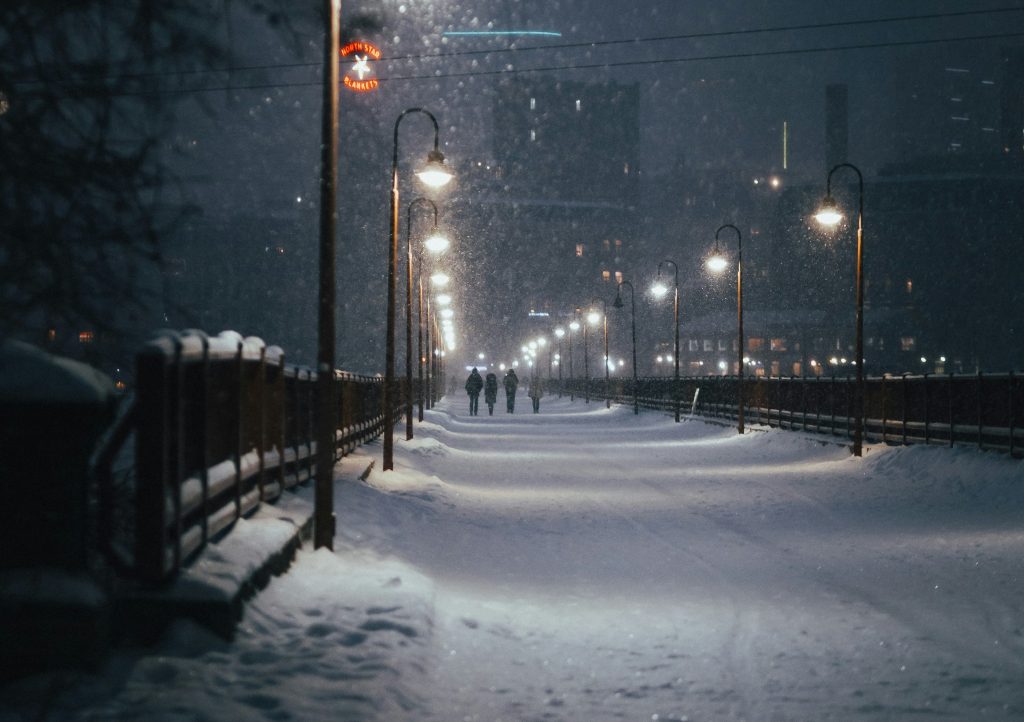
In the City of Lakes, humanity is standing peacefully against bitterly cold winds of injustice. We have a chance to make the world a better place.
That is what’s next.
 The Poet Economist