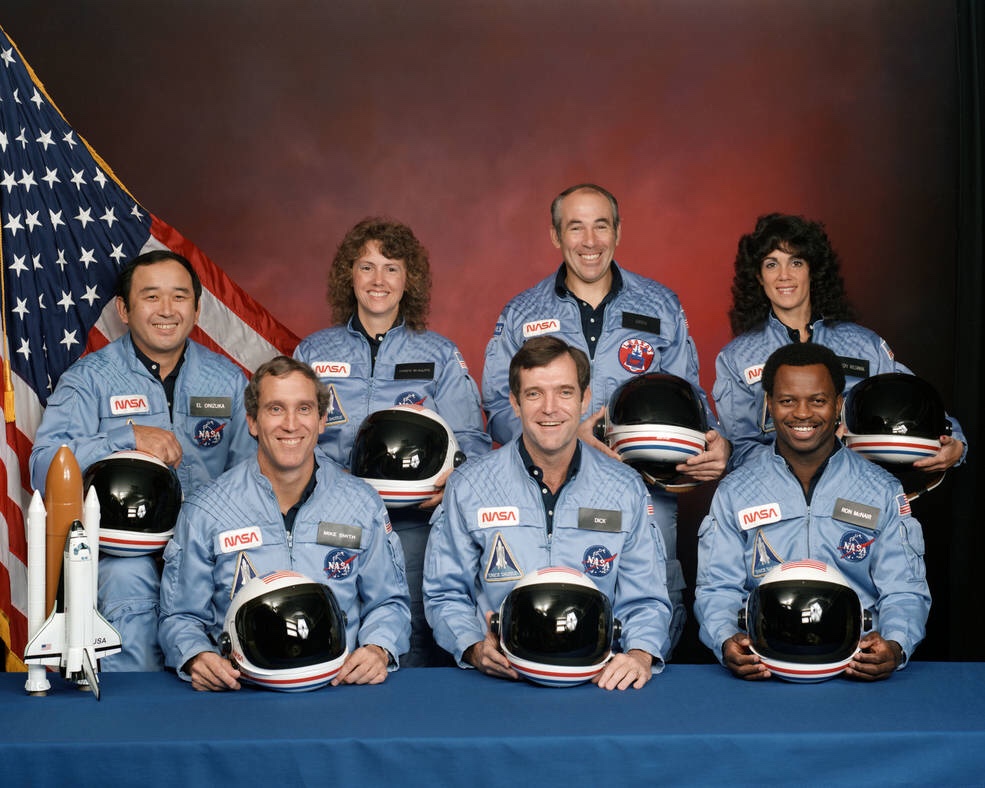
40 years ago this week, on January 28, 1986, the Space Shuttle Challenger exploded. It was a moment of national shock and unity, because millions of schoolchildren were watching live as it happened. Christa McAuliffe was aboard, a teacher who trained to be the first civilian astronaut in space.
That millions of children were watching, while a person like the teachers in the room with them in that moment was killed, along with other brave astronauts, caused the nation to confront central questions about our common purpose, about danger and devotion.
That night, President Reagan addressed the nation in a somber, humble, and dignified manner. He gave a beautiful address which I can still remember as a comforting conclusion to a horrific day.
That speech, written by Peggy Noonan and quoting the poem ‘High Flight‘ by John Gillespie Magee, Jr., ended with these words:
The crew of the space shuttle Challenger honored us by the manner in which they lived their lives. We will never forget them, nor the last time we saw them, this morning, as they prepared for their journey and waved goodbye and “slipped the surly bonds of earth” to “touch the face of God.”
I noted this recently, while reflecting on the national horror of the shooting death of Renee Good, but the fact we are lacking this unifying leadership and that millions are being intentionally terrified by the President, makes it necessary to keep talking about the better way of understanding, speaking about, and leading our shared project as a country.
A society of free people sinks or swims together. We have to have each other’s backs. We have to respect the life and humanity of everyone.
Christa McAuliffe celebrated the way in which the Teacher in Space program had focused the nation’s attention on the noble and necessary work of teachers and school systems. They work to make the best possible future possible not only for individuals and communities, but for the whole of society. Of this inspired work, she said:
“I touch the future; I teach.”
The astronauts who died aboard the Challenger four decades ago sacrificed their lives to the pursuit of science, in service of our common need, our common mission—to access and understand our universe, to expand our capabilities, to inform the future with evidence and its forthright cooperative application.
That commitment, that vocation, reveals by its example an underlying shared endeavor.
- We cannot know the universe on our own; we need to talk with others, read the writings of others, find facts faithfully delivered by honorable professionals who investigate, verify, and report facts.
- We need to navigate complex cascading landscapes of opportunity and choice, risk and rescue.
- We need to be able to use our minds in an open and agile, focused and critical way, to avoid falling for shadings of truth shopped around by our political allies.
- Learning how the universe works, and how we can stay safe while moving through it, is a complex, necessarily collective project.
In the opening of the television series Cosmos, astrophysicist Neil DeGrasse Tyson describes the history of science as:
“one adventure, with many heroes.”
The history of science is collaborative. Explorers learn from each other, benefit from successes and from failures of others. This is what it means to develop intelligence as a society, as a civilization, as a species. The human endeavor has this unique quality—a universal shared pursuit of facts and evidence, truth and acumen.
What Christa McAuliffe and the Challenger crew signaled, with their hard work, their risk-taking, and their tragic sacrifice, is that we need each generation to be well prepared to do the best quality science for the benefit of everyone. We should honor their legacy by making sure we invest in the best quality education for everyone, regardless of where they live.
We also need to recognize that investing in science is a shared responsibility. Article I, Section 8, of the U.S. Constitution requires Congress to “advance science and useful arts” for what the Preamble describes as “the general Welfare” and securing “the Blessings of Liberty to ourselves and our Posterity…”
50 years after taking his famous ‘Earthrise‘ photo, Bill Anders wrote:
Hundreds of thousands of people labored together to move us, as astronauts, as Americans, as humans forward. The most significant revelation of Apollo 8’s journey extends far beyond our scientific-and-technological achievements, beyond our “records” and “firsts.” We set out to explore the moon and instead discovered the Earth.
We move forward, we gain knowledge, we liberate ourselves from darkness and danger, together.
In 2026, we have special, unfortunately necessary work to do to restore funding unilaterally taken away from research institutions, medical science, scientific observation of planetary health, and high-quality reporting and sharing of the relevant data with communities around the country, to help them prepare for and avoid disaster. The defunding of science has put American lives, fiscal health, and security, at risk.
40 years after the tragic loss of the Challenger crew, we have an unprecedented need for new and thorough knowledge about our relationship to this planet we call home. We must remember what is given in the pursuit of knowledge and a more capable future, and so make sure we study, comprehend, and act responsibly toward our special, flourishing, yet fragile cosmic home.
 The Poet Economist