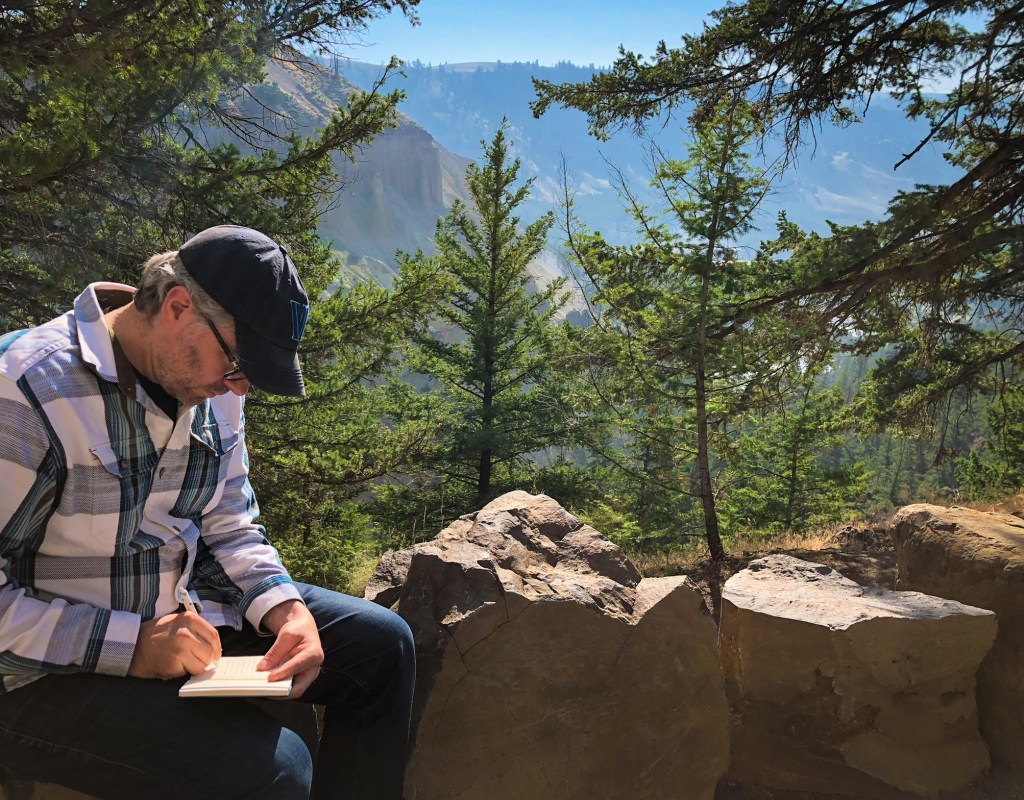
The nickname ‘Poet Economist’ was given to me by a group of friends, precisely because I am not a formally trained economist, but I have written, edited, and published poetry, and take a poet’s view of the need to expand our awareness and understanding.
My work in economic analysis started with the practice of reporting on the politics of economic decision-making, on climate-related and ecological economics, and on the ways in which macrocritical forces (which shape the overall potential of an economy) affect human wellbeing and planetary health.
My background is in philosophy, literature, and language. I have published and edited poetry, in English and Spanish, as well as fiction and nonfiction, and over time became aware of important connections between the poetic space (where we expand our languages, our thinking, and our expression) and the insight challenge of assessing value, impact, and meaning, through economics.
- Poets are expected to seek an intuitive detachment from the mechanics of the material world, to go beyond what is evident and to reveal and transmit catalytic insights hidden between the details.
- Economists are expected to seek an arithmetical detachment from the blush of human experience, to treat the mechanics of material exchange as a window into the more fluid space of human intention.
But the truth is:
- Poetry is inherently economical in practice—working to trace not the longest but the shortest path to clear and transcendent meaning, leveraging unexpected and unusual descriptions to reveal living realities the reader can recognize as already happening inside and around them.
- Economics without ecological insight—economics without a focus on the dynamics of mutual thriving—is incomplete; it risks becoming a useful story about storytelling, but not a story about what is lived.
- Numbers alone do not capture the deeper truths of human experience; it is insight, which often comes from specific efforts to combine and cross-reference, or go beyond data, that tells us whether numerical trends reflect real improvements to wellbeing.
- The poetry of what happens at the human scale that matters, if numbers and theories are to affect the world for the better. No economic judgment can escape the rigor of that standard.
- Economics without some implicit sense of the poetical risks degrading what is human in each of us—because we are not simply resources and statistics. To discount the human or ecological is to miss a critical piece of the overall math.
Poetic exploration and economic analysis are two broad categories that encompass countless ways of reviewing what is knowable, or discoverable, in the hidden fabric of human intention, or in the dynamics of a world that makes meaning with or without our consent. To be honest, we need to recognize that what we seek is to illuminate a fabric of consciousness which looks for the sacred in human experience, and looks for ways to cultivate, propagate and defend what is worthy of our time, attention, talent, and sacrifice.
I don’t mean that money is sacred, or that it should be treated as such. I mean that what economics really looks for—if the expert remains unafraid to ask the difficult question—is the way in which measurable interactions between people express what is valuable about the human experience. Economics at its best reveals to what what degree everyday activities empower actual people to achieve health-building outcomes, shared security and prosperity.
Whenever you see a news report about economic data, ask yourself this question: Does an upward trend reflect an expansion of agency for the average person, or for the most marginal?
We can build a political economy of virtuous abundance, if we focus on what matters at the human scale. We can also fail, monumentally and tragically, if we give in to the twisted mythology of infinite growth driven by the false assumption that facilitated exploitation will have no corrosive impact.
Exploitative activities always undermine wellbeing, somewhere, somehow. If we do not consider that, we cannot speak truthfully about any part of the landscape of human interaction.
A sense of the poet’s duty is required to illustrate that all true economics is nonlinear, dynamic, compounding, and onto-phenomenological—meaning: the question of what we live and so of how we perceive the meaning of our experience, is tied up in it.
Poetry is a way of creating new space for revealing what is human about our experience. That way of working should shape our approach to building a healthy economic future.
Why ‘Poet Economist’? Because everything matters.
For more about my work on climate policy, economics, food systems, and finance innovation, including a review of milestones, visit jro3.net.
 The Poet Economist